Time Zone Transitions and Their Ties to Turnover Spikes During NBA Cross-Country Jaunts
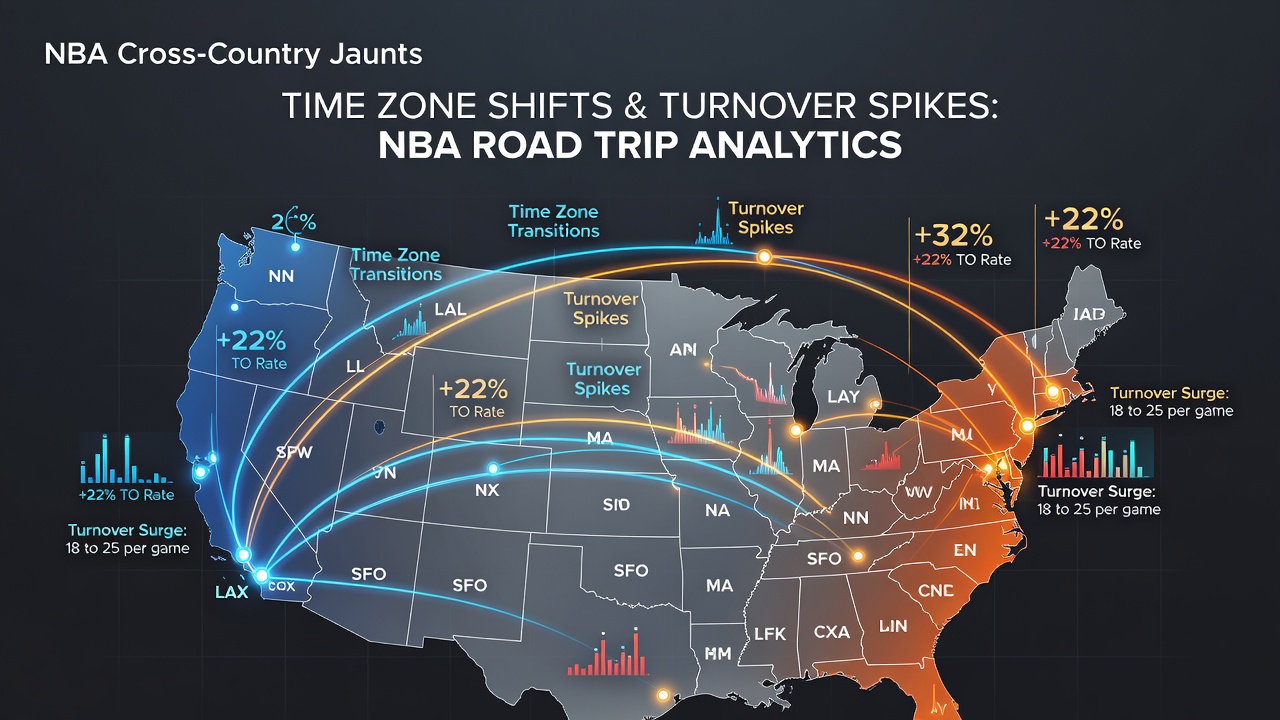
Cross-country travel in the NBA creates measurable disruptions in player performance, particularly when teams move between the Eastern and Pacific time zones, and observers note consistent patterns in turnover rates that align with these shifts.
Teams often cover three time zones during a single jaunt, which forces circadian rhythms to adjust over several days while game schedules remain fixed, and data collected across multiple seasons shows elevated turnovers in the first contest after such flights.
How Circadian Disruption Develops During Travel
Players lose sleep on overnight flights or experience fragmented rest in new hotel environments, and researchers tracking heart-rate variability plus reaction-time tests have documented slower decision-making on the court once those athletes suit up, whereas home teams maintain their normal sleep cycles and preparation routines.
Eastbound trips tend to compress the day and leave athletes fighting an earlier bedtime, while westbound journeys extend the evening and push wake times later, yet both directions produce the same downstream effect on ball security because fatigue impairs peripheral vision and quick-twitch responses needed to protect the dribble or execute crisp passes.
Statistical Patterns in Turnover Data
League-wide box-score archives reveal that visiting clubs average 2.3 additional turnovers per game when they cross three time zones compared with intra-conference games that involve minimal clock adjustment, and this margin widens during back-to-back sets when recovery windows shrink below forty-eight hours.
Figures compiled by performance analysts indicate the spike concentrates in the first and third quarters, moments when accumulated jet-lag effects intersect with the highest physical demands, while fourth-quarter numbers sometimes normalize as adrenaline temporarily masks underlying tiredness.
Concrete Examples From Recent Seasons
The Boston Celtics traveled from Logan International to Los Angeles International in January 2025 and recorded seventeen turnovers in their first game against the Lakers, six above their season average, and similar elevations appeared when the Golden State Warriors flew east for a three-game swing that began in Boston the following week.
Coaches adjust film sessions and practice intensity during these windows, yet the physiological toll remains visible in metrics such as assist-to-turnover ratio, which drops measurably until the third or fourth night in the new time zone.
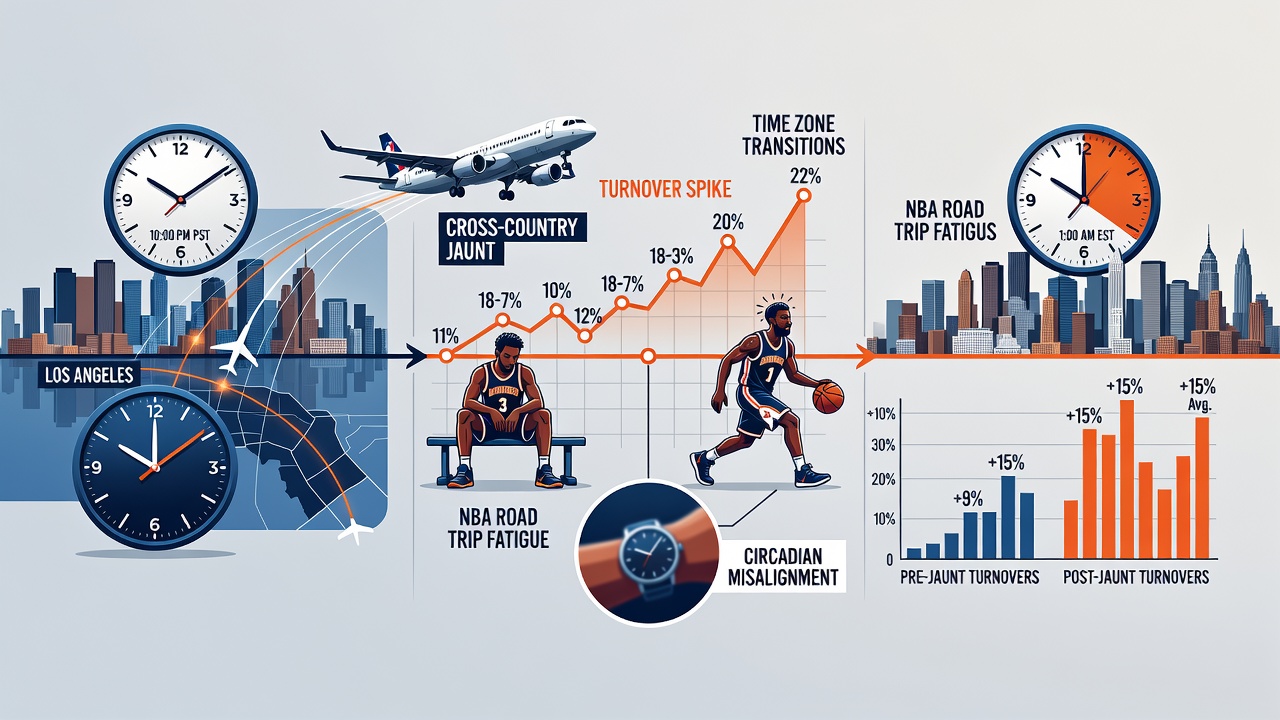
July 2026 brings renewed attention to schedule construction as front offices finalize 2026-2027 calendars, and analysts already flag early-season trips between the coasts because historical data shows those matchups produce the clearest turnover differentials before teams adapt to their new environments.
Recovery Protocols and Their Measured Impact
Teams increasingly deploy light-exposure therapy, targeted napping schedules, and nutrition timing to accelerate circadian realignment, and studies conducted at the University of Toronto have tracked athletes who followed such protocols and recorded turnover rates that returned to baseline twenty-four hours sooner than control groups.
Nutritionists adjust meal timing to match destination clocks even before departure, while strength coaches reduce high-intensity lifting on travel days, and these combined steps narrow but do not eliminate the statistical gap between rested and recently traveled squads.
According to information from the Centers for Disease Control and Prevention, adults require consistent sleep timing to maintain cognitive sharpness, and the same principle applies to elite athletes whose margins for error sit far below those of the general population.
League-Wide Scheduling Considerations
The NBA schedule makers balance television windows, arena availability, and player-rest mandates, yet cross-country flights remain unavoidable for a thirty-team league spanning four time zones, and performance-tracking firms continue supplying teams with granular reports that quantify how many extra possessions each road club loses after specific flight distances.
Future adjustments may include more four-game homestands or condensed travel clusters, but current patterns suggest turnover spikes will persist whenever the calendar places a Pacific team in Boston on a Tuesday night after a Sunday contest in Portland.
Conclusion
Time-zone transitions produce repeatable elevations in NBA turnovers because circadian misalignment slows reaction speed and decision accuracy, and the effect registers most clearly in the opening games of extended road trips. Teams that implement structured recovery protocols reduce the duration of the deficit, yet the underlying physiological challenge remains tied to geography and the fixed nature of game times. Data accumulated across multiple seasons continues to map these relationships, giving coaches and analysts clearer benchmarks for anticipating performance fluctuations during cross-country jaunts.