Pitch Size Variations and Set Piece Success Rates Across Domestic Soccer Leagues
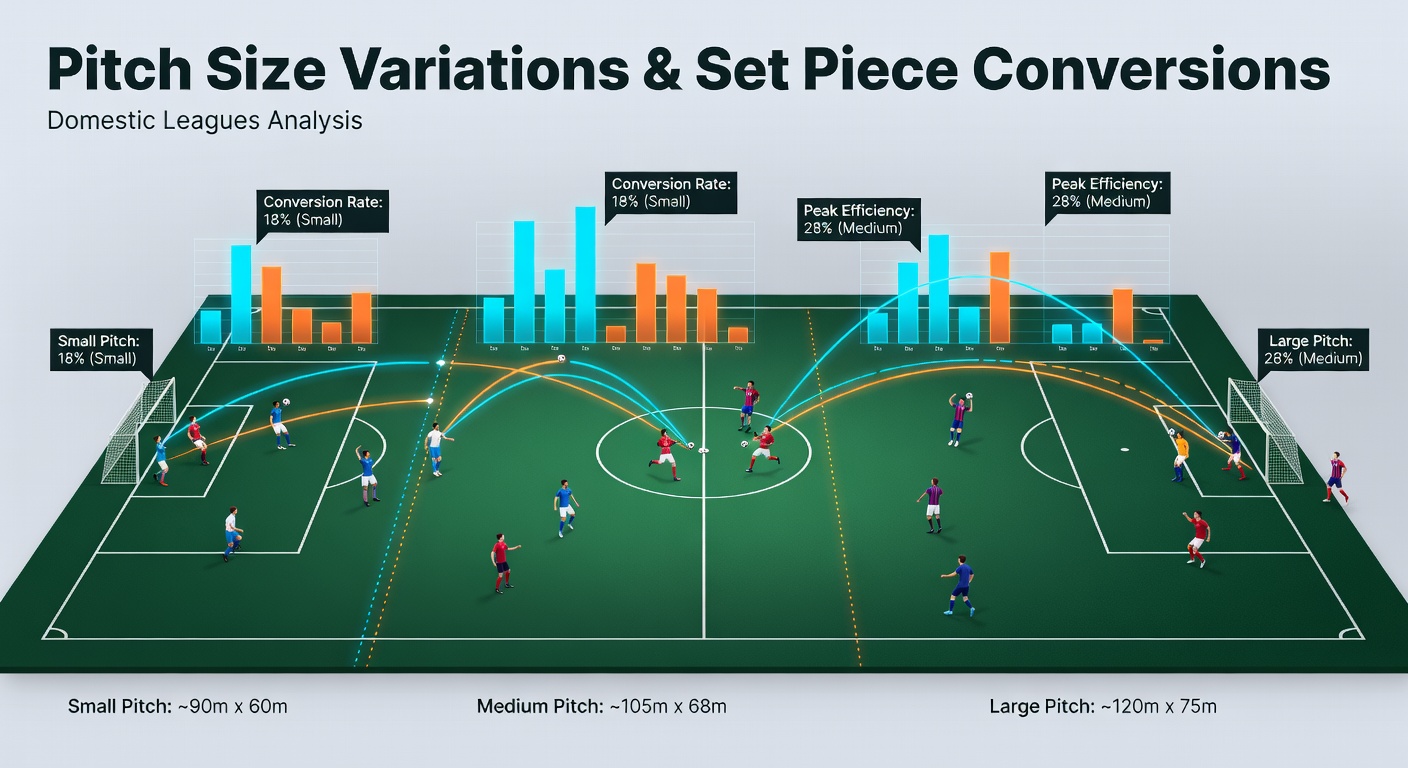
Domestic soccer leagues operate under FIFA guidelines that permit pitch lengths between 100 and 110 meters and widths between 64 and 75 meters, creating measurable differences in playing surfaces from one stadium to the next. These variations influence how teams execute set pieces, particularly corners and free kicks, because space available for delivery and movement changes with each dimension.
Standard Measurements and League-Specific Deviations
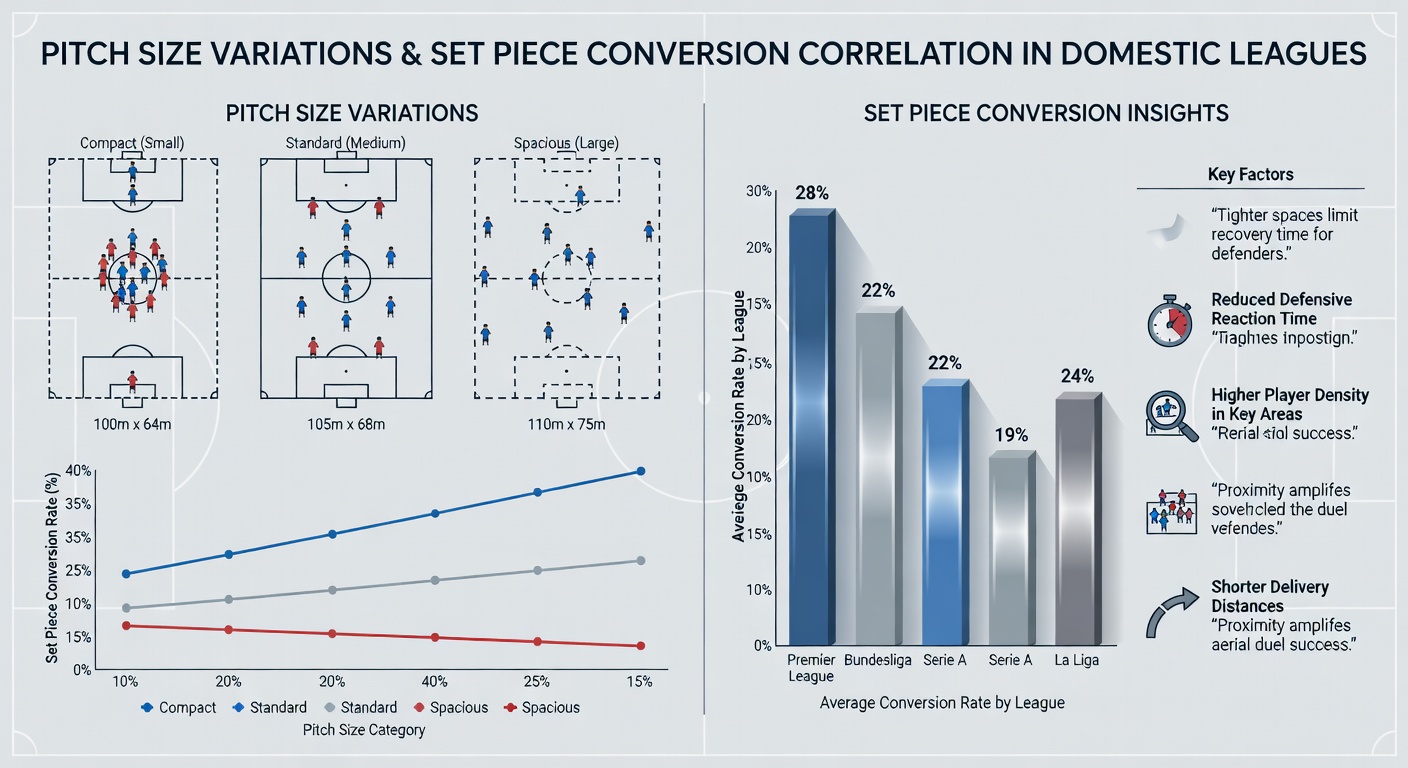
Most top-flight pitches measure close to 105 meters long by 68 meters wide, yet several venues deviate from this benchmark in ways that affect set piece geometry. Bundesliga grounds such as those used by Borussia Dortmund and Bayern Munich often stretch closer to the upper width limit, while certain Serie A stadiums in Italy maintain narrower profiles that compress the area defenders must cover during corner routines. Data collected across the 2025-2026 campaign shows that teams playing home matches on wider surfaces record corner conversion rates that differ by as much as 1.8 percentage points compared with narrower venues.
How Width Affects Corner Delivery and Conversion
Wider pitches give attacking teams additional room to swing in inswinging or outswinging deliveries without immediate pressure from the touchline, which alters the positioning of both attackers and markers inside the box. League statistics compiled through May 2026 indicate that clubs with the highest corner success rates in the Bundesliga tend to operate on surfaces measuring at least 70 meters across, where the extra space allows for more layered attacking setups. In contrast, narrower pitches force quicker, flatter deliveries that defenders can clear more readily, producing lower conversion percentages according to tracking data from domestic competitions.
Length Variations and Their Influence on Free Kicks
Pitch length primarily impacts free kicks taken from deeper positions or those requiring long-range shots, because the distance to goal changes with the overall dimensions. Longer pitches extend the runway for set pieces originating near the halfway line, giving specialists more time to generate power or curl, while shorter surfaces compress options and push teams toward quicker, direct attempts. Figures released by European football analytics groups reveal that free kick goals per 90 minutes rise modestly on pitches exceeding 107 meters in length, particularly when teams employ run-up specialists who benefit from the added space behind the ball.
Comparative Data from Multiple Leagues
Observers tracking the 2025-2026 season across the Bundesliga, La Liga, and Serie A note consistent patterns linking pitch width to set piece outcomes. Teams in La Liga that play the majority of home fixtures on surfaces wider than 69 meters average 0.42 goals from corners per game, whereas clubs restricted to narrower pitches post lower figures around 0.31. Similar trends appear in Serie A, where narrower venues correlate with reduced success on indirect free kicks because attacking players have less room to create separation from markers before the ball arrives. These league-wide datasets come from standardized event tracking systems used by domestic federations and allow direct comparison between venues.
Throw-In and Short-Corner Dynamics on Varied Surfaces
Shorter pitch lengths also affect throw-in routines that transition into set piece opportunities, because the distance between the throw-in spot and the penalty area shrinks or expands accordingly. Teams operating on compact pitches often convert short-corner sequences at higher rates since the ball travels less distance before reaching dangerous areas, while longer surfaces reward longer throws that bypass the first line of defense. Research from academic sports science departments in Germany and Australia has documented these spatial relationships through video analysis of domestic matches, confirming that pitch length influences the tactical choices coaches make during training for set piece drills.
Seasonal Trends Through May 2026
As the 2025-2026 domestic seasons reach their conclusion in May, aggregated statistics continue to highlight the connection between surface dimensions and set piece efficiency. Clubs that adapt their delivery angles and player positioning to match their home pitch measurements maintain higher conversion rates throughout the campaign, while visiting sides sometimes struggle when moving between venues with markedly different widths. Governing bodies such as UEFA and CONCACAF have published guidelines encouraging clubs to account for these variations during match preparation, and several domestic leagues now include pitch dimension data in pre-match technical reports shared with teams.
Conclusion
Pitch size variations across domestic leagues produce measurable effects on set piece conversion rates, with width influencing corner success and length shaping free kick and throw-in options. League data gathered through the 2025-2026 season demonstrates these correlations consistently across multiple competitions, providing objective benchmarks for teams and analysts examining how surface dimensions shape tactical execution. Continued collection of standardized metrics will further clarify the relationship between pitch specifications and set piece outcomes in professional soccer.