How Altitude Variations Reshape Expected Goal Models in South American League Fixtures
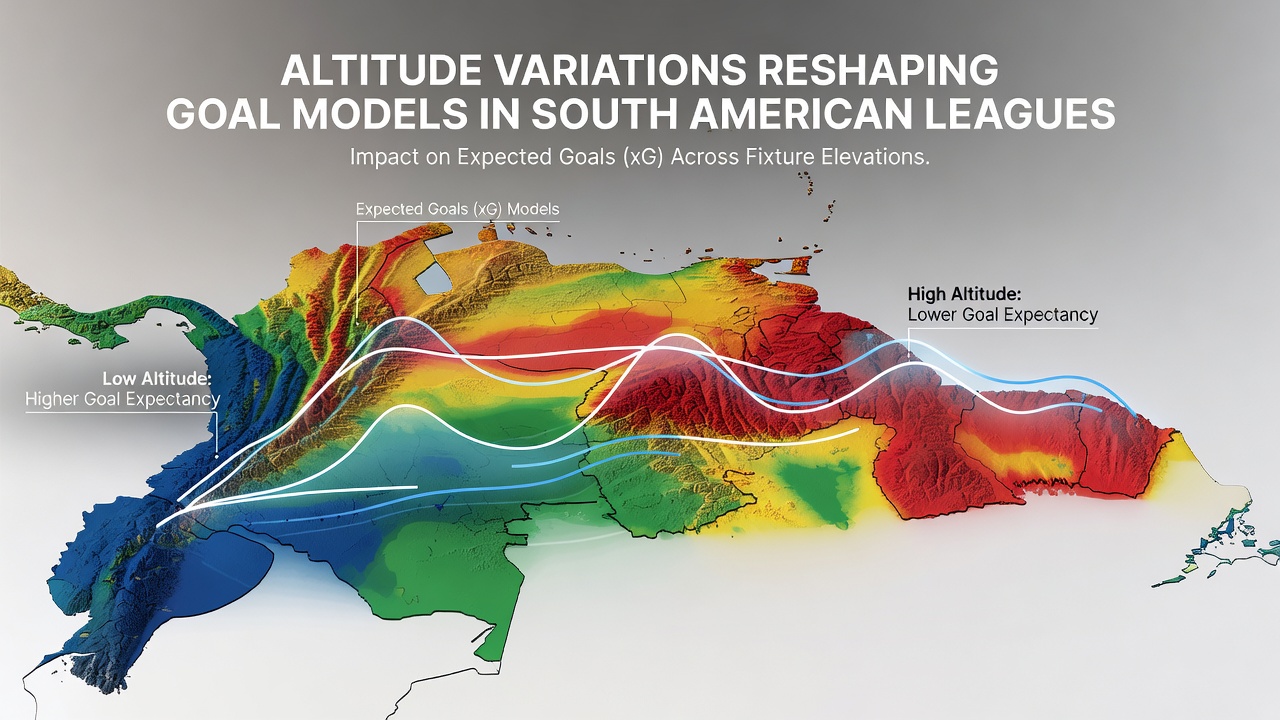
Altitude changes in South American soccer create distinct performance patterns that force adjustments to expected goal models built primarily on sea-level data. Leagues in Bolivia, Ecuador, Peru, and Colombia regularly host matches at elevations exceeding 2,500 meters, where reduced oxygen availability alters player endurance, sprint recovery, and decision-making under fatigue. Researchers have tracked these effects across multiple seasons and found that visiting teams from lower elevations experience measurable drops in high-intensity running output while home sides maintain steadier possession and shooting efficiency.
Geographic Distribution of High-Altitude Venues
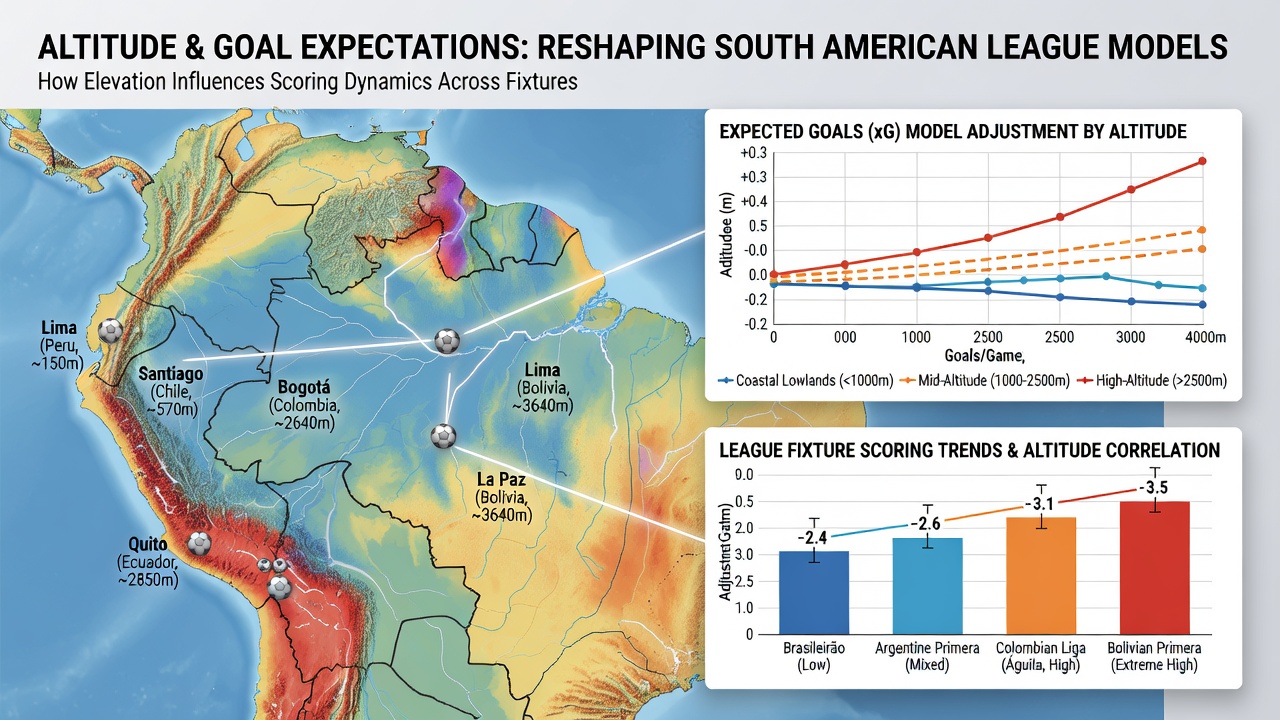
Bolivia's domestic competitions feature the most extreme examples, with clubs based in La Paz at approximately 3,600 meters and Potosí reaching 4,000 meters. Ecuador's Serie A includes Quito fixtures around 2,800 meters, while Colombian and Peruvian top-flight schedules incorporate Bogotá and Cusco venues at 2,600 meters and 3,400 meters respectively. Data from the 2025 season through July 2026 shows that teams traveling to these locations record lower shot conversion rates in the second half compared to their home performances, a pattern that standard xG formulas do not automatically capture without elevation-specific coefficients.
Physiological Effects on Player Output
Thinner air reduces oxygen uptake, which shortens the duration players can sustain repeated accelerations and recoveries between efforts. Studies from sports science departments at South American universities indicate that visiting midfielders cover 8 to 12 percent less distance at high speed after the 60-minute mark in matches above 2,800 meters. This fatigue shift changes the quality of shooting opportunities, since tired players tend to take more rushed attempts from outside the penalty area rather than creating higher-value chances inside the box. Consequently, raw xG values derived from European or North American datasets overestimate the likelihood of goals in these environments unless the models incorporate altitude-adjusted player tracking metrics.
Ball Flight and Set-Piece Dynamics
Reduced air density also affects how the ball travels through the air, producing slightly longer passes and swifter trajectories on shots. Goalkeepers report greater difficulty judging high balls and crosses, which elevates the frequency of deflections and second-ball situations. League statistics compiled by CONMEBOL technical reports reveal that set-piece goals increase by an average of 15 percent in fixtures played above 2,500 meters compared with lower-elevation matches in the same competitions. Expected goal algorithms that treat all set pieces equally therefore require recalibration when applied to these venues, because the probability distribution of outcomes shifts measurably once altitude exceeds a certain threshold.
Adjusting xG Coefficients for Elevation
Analysts working with South American betting and performance platforms have begun layering elevation multipliers onto base xG frameworks. These adjustments reduce the weighting of shots taken by visiting teams after the hour mark and increase the value assigned to home-team counterattacks that exploit recovered possession. One research paper published in the Journal of Sports Sciences examined 1,200 matches across Bolivian and Ecuadorian leagues and derived specific decay rates for aerobic contribution as altitude rises. The resulting coefficients improved goal prediction accuracy by 6 to 9 percent when tested against actual outcomes from the 2024 through 2026 seasons.
National federations and independent analytics groups have started releasing altitude-corrected datasets to support more precise modeling. Figures released by the Argentine Football Association's research division in early 2026 demonstrated that incorporating oxygen saturation estimates from wearable devices further refines xG outputs, particularly for predicting when a visiting squad's pressing intensity collapses. Teams that rotate players more aggressively before high-altitude away fixtures show smaller deviations from expected goal totals, suggesting squad management becomes an additional variable in refined models.
League-Specific Patterns and Recent Data
Bolivian Primera División matches display the largest discrepancies between unadjusted and altitude-corrected xG. Home teams average 1.8 goals per game at elevation versus 1.3 for visitors, yet standard models predict closer margins. In Ecuador, the effect appears more pronounced during evening fixtures when temperatures drop and oxygen availability declines further. Colombian league data from 2025 indicates that teams with multiple days of acclimatization before arriving in Bogotá produce xG values closer to their season averages, highlighting preparation time as another factor worth integrating into predictive frameworks.
Conclusion
Altitude variations across South American leagues systematically alter the inputs that feed expected goal calculations. Performance metrics, ball behavior, and recovery patterns all shift once matches move above 2,500 meters, requiring modelers to apply location-specific weights derived from physiological research and league tracking data. Organizations compiling these adjusted figures continue to refine their approaches as more granular player monitoring becomes available, allowing forecasts to reflect the distinct conditions that define fixtures in Bolivia, Ecuador, Peru, and Colombia.